Power & Batteries
Why Chargers Stopped Caring Which Country You Are In
Travel adapters used to convert voltage as well as plug shape, and the reason they no longer need to is a change in how power supplies work internally.

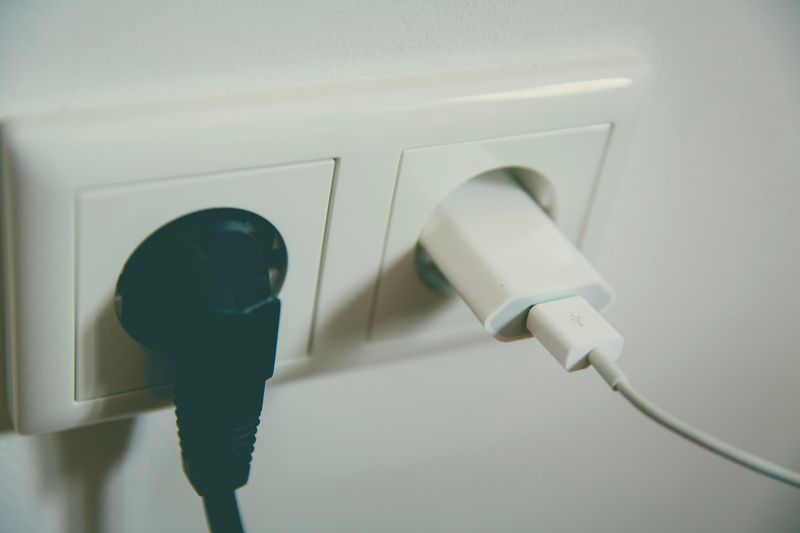
A modern charger works on any mains supply in the world with nothing more than a plug adapter. This is recent, and it follows from abandoning the transformer.
Old supplies were tied to their input
A traditional supply used a mains transformer whose turns ratio fixed the relationship between input and output voltage.
That ratio is physical. Feeding such a unit a different supply voltage produced a proportionally different output, which the electronics behind it could not tolerate.
Frequency mattered too, since a transformer designed for one frequency runs hotter and saturates on a lower one. Devices were built for a region and stayed there.
Switching supplies rectify first
A modern supply rectifies the incoming mains immediately, producing a high direct voltage before any conversion happens.
That voltage is then chopped at a very high frequency and fed through a small transformer. Because the frequency is chosen by the circuit, the input frequency stops mattering.
Output is regulated by adjusting how long each pulse lasts. A supply that receives a higher input simply shortens its pulses and produces the same output.
Wide input range is a control problem
Accepting anything from roughly a hundred to two hundred and fifty volts means the controller must cope with a large variation in the internal rectified voltage.
Components must be rated for the highest case while the control loop stays stable at the lowest, which sets the range rather than any fundamental barrier.
The high-frequency transformer is small because size falls as frequency rises. This is the same reason chargers shrank so dramatically.
Current changes even when power does not
Delivering the same power from a lower supply voltage requires proportionally more current from the wall.
This is why some equipment specifies a different plug fuse or cable in different regions, and why an appliance may draw noticeably more current abroad while behaving identically.
It also means the same device stresses the socket and lead more in a low-voltage region, which is a design consideration rather than a user one.
Heating appliances did not follow
Anything whose function is producing heat has its power set directly by voltage and resistance, with no electronics between the two.
Such an appliance on the wrong supply delivers roughly a quarter or four times its intended power. Neither outcome is acceptable and one is dangerous.
This is why hairdryers and travel kettles remain the exception that genuinely needs a converter, while everything with a charger needs only the right shaped pins.
Questions readers ask
Will supercapacitors replace batteries?
Not for storing energy over hours. The mechanism stores far less per kilogram, and that is a physical property rather than an engineering gap.
Are they dangerous?
A charged one can deliver an enormous short-circuit current very quickly, so handling terminals carelessly is the main hazard.