Power & Batteries
Wireless charging wastes energy as heat, and the heat is the real cost
Inductive charging trades a measurable amount of efficiency for convenience, and the losses land inside the device next to the battery.
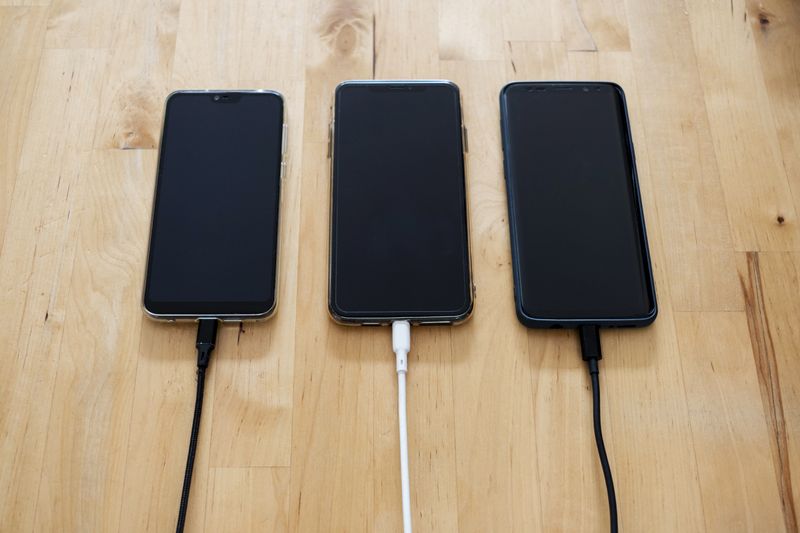
There is a settled way of talking about wireless charging. It is worth asking how much of it survives contact with the detail.
The argument in brief
- Energy transfers through a magnetic field between two coils, imperfectly.
- Misalignment increases loss sharply and the device cannot tell you.
- Waste heat is generated inside the phone, where the battery is.
Two coils and a changing field
The charging pad drives alternating current through a coil, producing a changing magnetic field that induces current in a matching coil inside the device. The two coils form a loosely coupled transformer, and loose coupling is exactly what makes it convenient and inefficient. A conventional transformer has its windings on a shared iron core; here the medium is air, plastic and a case.
Every part of the field that does not pass through the receiving coil is energy that becomes heat somewhere.
Alignment dominates the losses
Coupling falls sharply with distance and with lateral offset, so a few millimetres of misalignment can cost a large fraction of the efficiency. Magnetic alignment systems exist precisely because guessing the position by eye is unreliable.
In the datasheet, thick cases, metal plates for magnetic mounts and cards in a wallet case all sit directly in the field path. The device reports that it is charging either way, so the user gets no feedback about how badly.
Where the wasted energy goes
Losses occur in the pad electronics, in the field, and in the receiving circuitry inside the device. The portion generated inside the device is the problem, because it warms the battery directly with no path for the heat to escape quickly. Heat is the dominant driver of lithium-ion capacity fade, which makes this the substantive argument against wireless charging.
Overnight wireless charging keeps a full battery slightly warm for hours, which is close to a worst case for cell longevity.
The efficiency numbers in context
Wired charging typically converts most of the wall energy into stored charge; wireless typically loses a substantially larger share. Published figures vary widely with alignment, case and power level, which is why a single number is not worth quoting. In household energy terms the waste is small; in battery ageing terms it is not negligible.
The honest framing is that you are paying in cell life rather than in electricity cost.
Faster wireless makes it worse
Higher power means proportionally more waste in absolute terms, so high-wattage wireless charging generates significant heat. Pads with fans exist for exactly this reason, and their noise is the sound of the trade-off being managed.
Devices throttle wireless charging rate as temperature rises, which is why the last portion often crawls. Charging wirelessly while using the device for anything demanding compounds both heat sources.
Firmware updates change this behaviour more often than hardware does.
Using it without paying much
Align carefully, remove thick or metal-bearing cases, and prefer a pad that positions the device consistently. Use wireless for daytime top-ups and wired for overnight, which puts the convenient method where heat exposure is short. Avoid charging in direct sun or on a warm surface, since the pad cannot dissipate heat downward through the device.
Mechanically, if a phone is uncomfortably warm on a pad, the arrangement is costing more battery life than the convenience is worth.
The takeaway
The convenience is real. So is the heat, and it is being generated next to the cell.
Understanding the failure mode tells you more than the feature list does.
Questions readers ask
Does wireless charging damage the battery?
Not directly, but the extra heat generated inside the device accelerates the normal ageing process. The magnitude depends heavily on alignment, power level and how long it sits there.
Why does my phone charge so slowly on a pad sometimes?
Poor alignment reduces coupling, and rising temperature causes the device to reduce the rate deliberately. Both are common and neither is a fault.