Power & Batteries
Two devices argue about voltage before any fast charge begins
A charger starts at a low safe default and stays there unless a conversation persuades it otherwise. Most slow charging is a failed conversation.
Everything here earned its place by changing an outcome. Nothing about charge negotiation is included to round the number up.
What matters most
- Power delivery begins at a safe default until both ends agree otherwise.
- Raising voltage rather than current keeps cable losses manageable.
- The cable itself participates and can cap what is offered.
Everything starts at the safe default
A charger cannot know what is plugged into it, so it offers a low voltage that will not damage anything unprepared for more. Only after both ends identify themselves and agree on a higher setting does the supply change what it is delivering. This is why an unrecognised device charges slowly rather than not at all, and why the fallback behaviour is so consistent.
The default also protects legacy equipment, which may have been designed long before higher voltage negotiation existed at all. Any breakdown in the conversation therefore results in slow charging rather than a failure, which makes the fault easy to overlook.
How the conversation actually happens
Some schemes signal by placing particular voltages on the data lines, which is crude but works with very simple hardware. Modern schemes send structured messages over a dedicated configuration wire, with the supply advertising what it can provide. The device examines the advertised options, selects one it can use safely and requests it, and the supply then switches over.
At the protocol level, the two can renegotiate at any time, which allows the device to ask for less as the battery fills or the case warms. Because it is a protocol rather than a voltage trick, either end can decline an option without any risk of damage.
Why raising voltage is the trick
Power is voltage multiplied by current, so more power can be delivered by increasing either one of those quantities. Losses in a cable rise with the square of the current, which makes pushing high current through thin wire expensive in heat.
Raising voltage instead delivers the same power at lower current, so the cable stays cooler and the losses stay small. The device then converts the higher voltage down to what the cell needs, and that conversion happens inside the device rather than the plug. Some designs split the cell into two sections or use a switching converter that halves the voltage very efficiently.
The cable is a participant, not a pipe
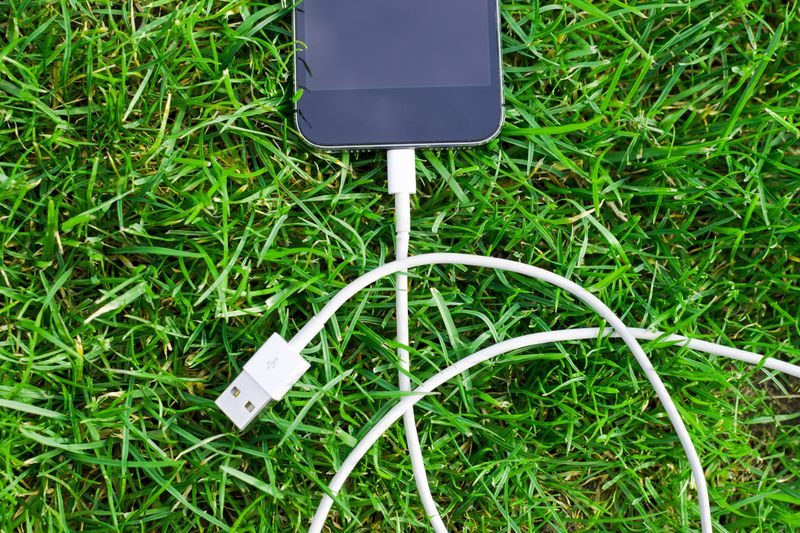
Cables rated for higher current contain an identification chip that tells the supply what the cable itself can safely carry. Without that chip, the supply assumes a conservative limit no matter how capable the charger and the device might be. A cable that is thin, long or damaged also drops more voltage, which the device may interpret as a supply that cannot cope.
In practice, this is the single most common reason that the same charger and phone behave differently with two apparently identical leads. Because the difference is invisible from outside, testing by swapping cables is more informative than reading anything printed on them.
Why the phone asks for less than it could take
Battery chemistry limits how fast a cell can accept charge without plating lithium or degrading, and that limit varies with temperature. The management system therefore requests power based on cell temperature, state of charge and its own history of the pack. A warm phone will reduce its request sharply, which is why fast charging slows down in a hot room or in direct sun.
Charging while gaming produces heat from two sources at once, and the system responds by cutting the charging half. None of this appears as an error; the device simply asks for less and the supply obliges without any complaint.
Diagnosing a slow charge
Start by establishing which component changed, since a supply, a cable, a connector and a device all sit in the same chain. Lint compacted in the socket is extremely common and prevents full contact, which limits current without preventing charging entirely.
The short version: a supply shared between two ports usually divides its capability, so unplugging the second device changes what the first receives. Charging while the screen is on can consume much of the incoming power, making a healthy charge look like a failure. If the device charges quickly when cold and slowly when warm, the negotiation is working and thermal limits are the cause.
Everything above, in order of what to do first
- Everything starts at the safe default. A charger cannot know what is plugged into it, so it offers a low voltage that will not damage anything unprepared for more.
- How the conversation actually happens. Some schemes signal by placing particular voltages on the data lines, which is crude but works with very simple hardware.
- Why raising voltage is the trick. Power is voltage multiplied by current, so more power can be delivered by increasing either one of those quantities.
- The cable is a participant, not a pipe. Cables rated for higher current contain an identification chip that tells the supply what the cable itself can safely carry.
- Why the phone asks for less than it could take. Battery chemistry limits how fast a cell can accept charge without plating lithium or degrading, and that limit varies with temperature.
- Diagnosing a slow charge. Start by establishing which component changed, since a supply, a cable, a connector and a device all sit in the same chain.
The takeaway
Fast charging is a negotiation, and a bad cable is a bad negotiator.
Once you know what it is trading away, the design stops looking arbitrary.
Questions readers ask
Can a more powerful charger damage my device?
No, provided both follow the standard. The device requests what it wants, and a supply does not force higher voltage onto anything.
Why does my charger get warm?
Conversion from mains to low voltage is efficient but not perfect, and the losses appear as heat. Warm is normal; too hot to hold is not.