Networks
Why Every Network Cable Has A Maximum Length
The hundred-metre limit on Ethernet is not a signal strength figure, it comes from the time a pulse takes to travel and return while a sender is still transmitting.

Network cabling has a length limit that has stayed roughly constant across generations of vastly faster equipment. The number originates in timing rather than in signal loss.
Early networks needed to detect collisions
Original Ethernet was a shared medium where any station could transmit at any time. Two stations transmitting together produced a collision that both had to notice.
A sender could only detect a collision while it was still transmitting. If it had finished, the corrupted signal would arrive with nothing left to interrupt.
That sets a relationship between the smallest permitted frame, the transmission rate and the time a signal takes to reach the far end and come back.
Signal speed makes it a distance
Electrical signals travel through copper at a large fraction of the speed of light, but not instantly. The round trip across a long cable takes a measurable time.
Working backwards from the minimum frame size gives a maximum round-trip time, and therefore a maximum distance. That calculation produced the familiar limit.
Later generations kept the distance even after switching removed collisions entirely, because the installed cabling and every specification already assumed it.
Attenuation sets the modern constraint
With collisions gone, the practical limit became signal quality. Copper attenuates high frequencies far more than low ones, and faster standards use higher frequencies.
Cable categories exist precisely to state how much frequency a given construction can carry over the standard distance while staying within an error budget.
This is why the fastest copper standards specify shorter distances for some cable types. The length limit is now a property of the cable rather than the protocol.
Crosstalk grows with length too
Adjacent pairs in a cable couple into each other, and the interference accumulates along the run. A long cable therefore has a worse ratio of signal to noise.
Bundling many cables tightly together adds coupling between cables as well as within them, which can push a nominally compliant installation over the edge.
Failures from this appear as intermittent errors and a link that negotiates a slower speed, rather than as a connection that simply does not work.
Glass changes the arithmetic completely
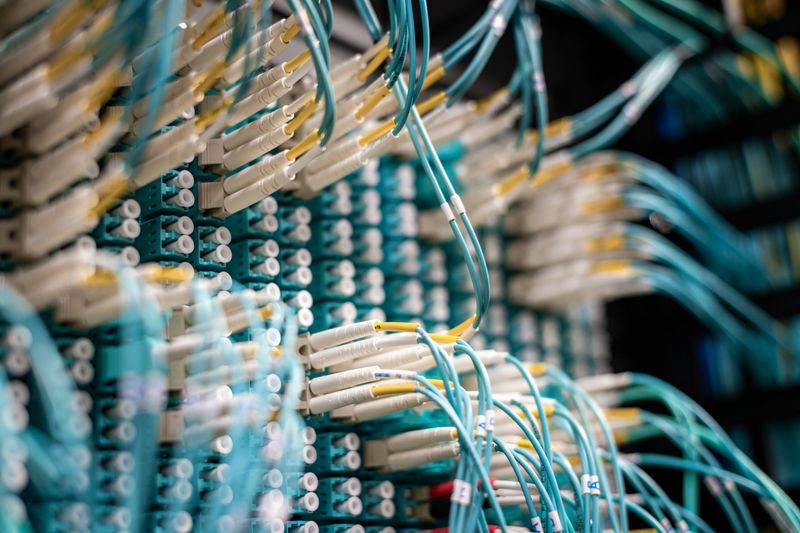
Optical fibre suffers far less attenuation and no electrical crosstalk at all, which is why runs are measured in hundreds of metres or kilometres.
Its limits come instead from the spreading of pulses over distance, which eventually blurs one symbol into the next.
Extending a copper run beyond its limit is therefore not a matter of accepting slightly worse performance. Beyond the boundary the link becomes unreliable rather than slow.
Questions readers ask
Is a mesh system better than a single powerful router?
Only where coverage is the limitation. One well-placed unit serving a small flat will beat three nodes relaying through each other.
Do more nodes always improve things?
No. Each wireless hop costs airtime, and nodes that hear each other well compete for the same channel. Two good positions beat four poor ones.